
.png)

Holiday Travel and Immigration Status: What You Need to Know Before Flying

By: Jarbath Peña Law Group

The holiday season is a time for connection, often involving travel to see family and friends. For many, booking a flight is a simple task. But if you are not a U.S. citizen, planning a trip—especially one outside the country—requires careful thought and preparation. Your ability to return to the United States depends on your specific immigration status and having the correct documents in hand. A simple oversight can lead to serious complications, turning a joyful reunion into a stressful legal problem.
Navigating travel rules can feel complex and intimidating, adding another layer of worry to your holiday plans. You deserve peace of mind when you travel. This guide provides essential information for individuals with different immigration statuses, outlining what you need to know before you book that flight. Understanding these rules is the first step toward a smooth and worry-free journey.
Lawful Permanent Residents (Green Card Holders)

As a Lawful Permanent Resident (LPR), you have the right to travel abroad and re-enter the United States. However, this right comes with important responsibilities. Your Green Card is proof of your status, but it's not a guarantee of re-entry.
Essential Documents for Travel
Your Valid, Unexpired Green Card: This is your primary document for re-entry. Ideally, you should not leave the country without a valid green card. However, if you filed for renewal before your card expired, your I-797C receipt notice automatically extends your residency and can be used for travel. If your card is lost, expired, or you did not file for renewal on time, you must take steps to replace it before traveling.
A Valid Passport: You must carry a valid passport from your country of citizenship — and to avoid potential issues with airlines or immigration, make sure the passport will remain valid for at least six months after your planned return date.
Re-entry Permit (for extended trips): If you plan to be outside the U.S. for one year or more, you must apply for a Re-entry Permit before you leave. A trip of this length without a permit can be seen as an abandonment of your residency, putting your Green Card at risk. Even for trips between six months and a year, a Re-entry Permit can help prove your intent to maintain U.S. residence.
Potential Risks
An LPR can be deemed "inadmissible" upon returning, just like any other non-citizen. Certain criminal convictions, for example, can make you inadmissible and jeopardize your status when you try to re-enter. It is vital to consult an attorney if you have any criminal history, no matter how minor it may seem.
Nonimmigrant Visa Holders (e.g., H-1B, F-1, B-2)

If you are in the U.S. on a temporary visa, such as a work visa (H-1B), student visa (F-1), or visitor visa (B-2), international travel requires careful planning.
Essential Documents for Travel
A Valid Passport: Your passport must be valid for at least six months beyond your intended period of stay in the U.S.
A Valid U.S. Visa Stamp: The visa stamp in your passport must be valid on the date you plan to re-enter the U.S. If your visa has expired, you will need to apply for a new one at a U.S. embassy or consulate abroad before you can return. This process can take time, so plan accordingly.
Supporting Documents: You should carry evidence of your current status.
H-1B workers: Bring your I-797 Approval Notice and recent pay stubs.
F-1 students: You must have a valid I-20 form with a recent travel signature from your Designated School Official (DSO). The signature is typically valid for one year.
B-2 visitors: Be prepared to show your ties to your home country and the temporary nature of your visit.
Individuals with Pending Applications
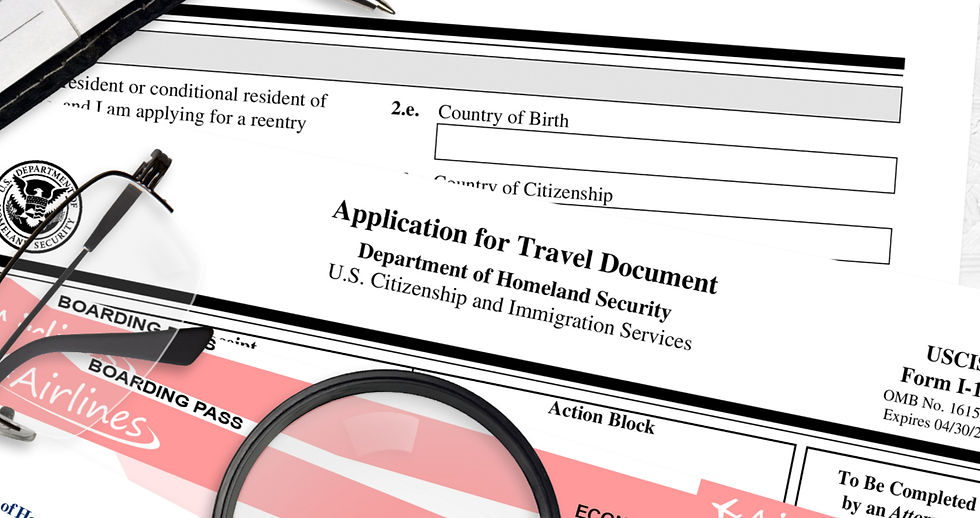
Traveling while an immigration application is pending is one of the riskiest and most complex situations. The consequences of leaving without the proper authorization can be severe, often resulting in the automatic denial of your pending case. We generally DO NOT RECOMMEND travel when there is a pending immigration application.
Advance Parole: Your Permission to Travel
If you have a pending application for Adjustment of Status (Form I-485 to get a Green Card), you must apply for and receive an Advance Parole document before you travel internationally. Advance Parole is a document that gives you permission to re-enter the U.S. while your application is being processed.
Who Needs It: Anyone with a pending I-485 application.
How to Get It: You apply using Form I-131, Application for Travel Document. Often, this is filed along with your I-485 and work permit application.
The Risk of Leaving Without It: If you leave the U.S. without Advance Parole while your I-485 is pending, USCIS will consider your application abandoned and will deny it. There are very few exceptions.
Advance Parole does not guarantee re-entry and it may still affect your pending application; a CBP officer will still make the final decision at the port of entry. However, traveling without it is a near-certain way to end your path to a Green Card.
DACA Recipients

For recipients of Deferred Action for Childhood Arrivals (DACA), travel outside the U.S. is extremely limited and requires special permission. DACA itself does not provide any travel authorization.
To travel, a DACA recipient must apply for and be granted Advance Parole. Under current policy, USCIS will only grant Advance Parole to DACA recipients for specific reasons:
Humanitarian Purposes: Such as to visit a sick relative or attend a funeral.
Educational Purposes: For study abroad programs.
Employment Purposes: For work assignments, interviews, or conferences.
Travel for vacation or leisure is not permitted. Leaving the country without an approved Advance Parole document will result in the termination of your DACA status, and you will likely not be allowed to return.
Why Legal Guidance is Essential for Holiday Travel

Immigration rules are complex and constantly changing. The information online can be confusing or outdated, and a mistake can have life-altering consequences. This is not a journey you should navigate alone. An experienced immigration attorney can provide the clarity and support you need.
At Jarbath Pena Law Group, we stand by you every step of the way. We see ourselves as your dedicated guides, ensuring you are prepared and protected.
We Assess Your Situation: We will carefully review your specific immigration status, travel plans, and any pending applications to identify potential risks.
We Ensure You Have the Right Documents: We will help you determine exactly what you need to travel, whether it’s applying for a Re-entry Permit or securing Advance Parole.
We Prepare You for Re-entry: We provide clear guidance on what to expect at the port of entry, so you can feel confident and prepared.
We Offer Peace of Mind: Knowing that an expert has reviewed your case allows you to focus on what matters most—enjoying your holiday with loved ones.
Your ability to live and work in the United States is too important to risk. Let us help you protect it.
Take the first step toward a worry-free holiday. Contact the Jarbath Pena Law Group today at 305-615-1005 or visit our website at www.jp-lawgroup.com to schedule a consultation.


Comments