
.png)

Can You Travel on a Work Permit?

By Jarbath Peña Law Group

Holding a U.S. work permit, officially known as an Employment Authorization Document (EAD), is a major milestone. It represents freedom and opportunity—the ability to work legally, earn a living, and support your family. With this new freedom, a natural and exciting question often comes up:
"Can I travel?"
You might want to visit family in another state, take a much-needed vacation, or even travel back to your home country for a special occasion. However, the answer to this seemingly simple question is more complex than a straightforward "yes" or "no." It depends entirely on where you want to go.
Think of your EAD as a key that unlocks the door to employment in the U.S. It is not, by itself, a key that unlocks travel outside the country. Understanding this distinction is crucial to protecting your immigration status and avoiding devastating mistakes. This guide will explain the rules for traveling with a work permit, both within the U.S. and abroad.
Traveling Within the United States: The Simple Answer

Let's start with the easy part: travel inside the U.S.
Yes, you can absolutely travel by air within the United States using your work permit. The Transportation Security Administration (TSA) accepts a valid, unexpired EAD card as a form of government-issued photo identification. This means you can book a flight from Miami to New York or from Fort Lauderdale to Los Angeles and use your EAD permit to get through airport security.
When traveling domestically, your EAD serves the same purpose as a driver's license or state ID card. Just make sure your EAD is not expired.
A quick tip: Before making any travel decisions — domestic or international — we strongly encourage you to speak with an immigration attorney who knows your specific case. Immigration enforcement priorities can shift, and what felt safe last year may carry different considerations today.
Traveling Outside the United States: The Misconception That Traps People

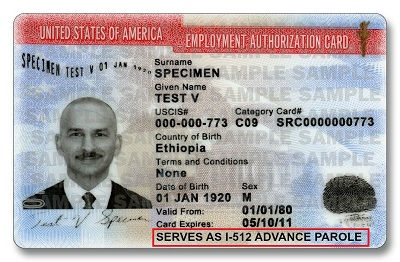
This is where we see one of the most dangerous misunderstandings in immigration law. Many people look at their EAD card, see the words “Serves as I-512 Advance Parole,” and assume they are cleared to travel internationally and return without any problem.
That assumption has destroyed cases that were otherwise on track.
Your standard EAD is an employment authorization document. It proves you are allowed to work in the United States. It is not a travel document. It does not guarantee your re-entry if you leave the country.
If you depart the United States with only a standard EAD—and you have a pending immigration application like an Adjustment of Status—you are likely abandoning that application the moment you leave. When you try to return, U.S. Customs and Border Protection (CBP) can deny your entry. You could find yourself stuck outside the country, separated from your family, with your case in ruins.
The Key to International Travel: Advance Parole
So, how can you travel internationally while your Green Card application is pending? The answer is a specific travel document called Advance Parole.
Think of Advance Parole like a permission slip from the U.S. government. It says, "We know you have a pending immigration case, and we are giving you permission to leave the country for a temporary trip and come back to continue your case."
For many people applying for a Green Card from within the U.S., the EAD and Advance Parole are combined into a single card. This is where the confusion comes from. If your EAD card has the words "Serves as I-512 Advance Parole" printed on it, then this card functions as both your work permit and your travel permit.
If your card does NOT have this specific language, it is only a work permit, and you need to apply for a separate Advance Parole document (Application for Travel Document) before you leave the country.
Having Advance Parole Does Not Mean Travel Is Risk-Free

Even with a valid Advance Parole document or a combo card, international travel is not without risk. It is crucial to understand that Advance Parole is not a guaranteed ticket back into the U.S.
When you return to a U.S. port of entry, a CBP officer will still inspect your case. They have the final say on whether to admit you. If they find a reason to believe you are "inadmissible"—for example, due to a past criminal conviction or immigration violation you weren't aware of—they can deny your entry.
This is why we say that Advance Parole is not a "get out of jail free" card. It simply preserves your pending application. It does not erase underlying inadmissibility issues.
If You Have Ever Been Unlawfully Present in the U.S.
If you have ever lived in the United States without legal status, leaving the country—even with Advance Parole—can trigger a 3-year or 10-year bar to re-entry. Advance Parole is designed to protect many Adjustment of Status applicants from this consequence, but the rules are nuanced and case-specific. What protects one person may not protect another.
Before you book any international travel, your full immigration history needs to be reviewed by an experienced attorney. This is not a step you can skip.
A Note for DACA and TPS Holders
For recipients of Deferred Action for Childhood Arrivals (DACA) and Temporary Protected Status (TPS), the rules around Advance Parole are even more specific. Travel authorization for these individuals is generally limited to humanitarian, educational, or employment purposes—not leisure travel—and the policies governing both programs have shifted significantly over time.
If you hold DACA or TPS and are considering any international travel, the stakes are high enough that a consultation with an immigration attorney is not optional. It is essential.
Your Work Permit Opened One Door. Make Sure You Know Which Ones It Does Not.

An EAD is a meaningful document. It represents hard work, patience, and a step forward in your immigration journey. But it is one piece of a larger picture—and treating it as a universal travel pass can unravel everything you have worked toward.
At Jarbath Peña Law Group, we help clients throughout Miami and South Florida understand exactly what their documents allow—and exactly what they do not. Before you make any travel decision that could affect your immigration status, let us review your case and give you an honest, complete picture.
The trip can wait. Your immigration case cannot afford a mistake.
Thinking about traveling and unsure if it is safe for your immigration case? Contact Jarbath Peña Law Group today at 305-615-1005 to schedule a consultation before you book anything.


Comments